 LINE
THE SHORT ANSWER
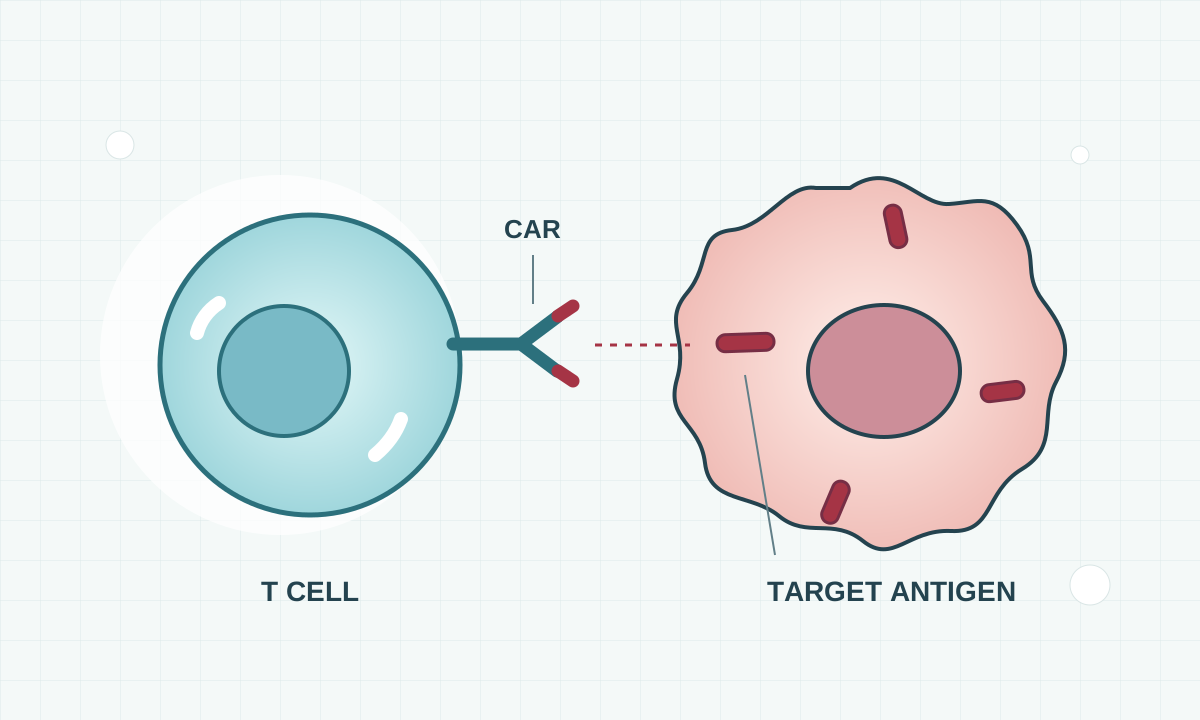
CAR T-cell therapy engineers T cells to express a chimeric antigen receptor (CAR), expands them and infuses them into a patient. It is an immune-cell treatment, not a cancer-screening blood test. [2]
- Established indications concern selected blood cancers.
- Many solid-tumour applications remain investigational.
- Patient selection and safety follow-up are essential.
Article information
Reviewer and approver details have not yet been provided. This does not indicate completed medical review or approval.
Written by
Scientific / medical reviewer
Approved by
What is CAR T-cell therapy?
T cells are white blood cells involved in immunity. A CAR is an engineered receptor that enables a T cell to bind a target on a cell’s surface, such as CD19 or BCMA, depending on the product. [2] [4] [5]
A CAR can be thought of as an added signal receiver. The analogy has limits: some targets also occur on healthy cells, and responses differ between patients. [6]
How does CAR T-cell therapy work?
The pathway below illustrates autologous CAR T-cell therapy, which uses the patient’s own cells. Assessment and follow-up require an experienced treatment team. [3] [12]
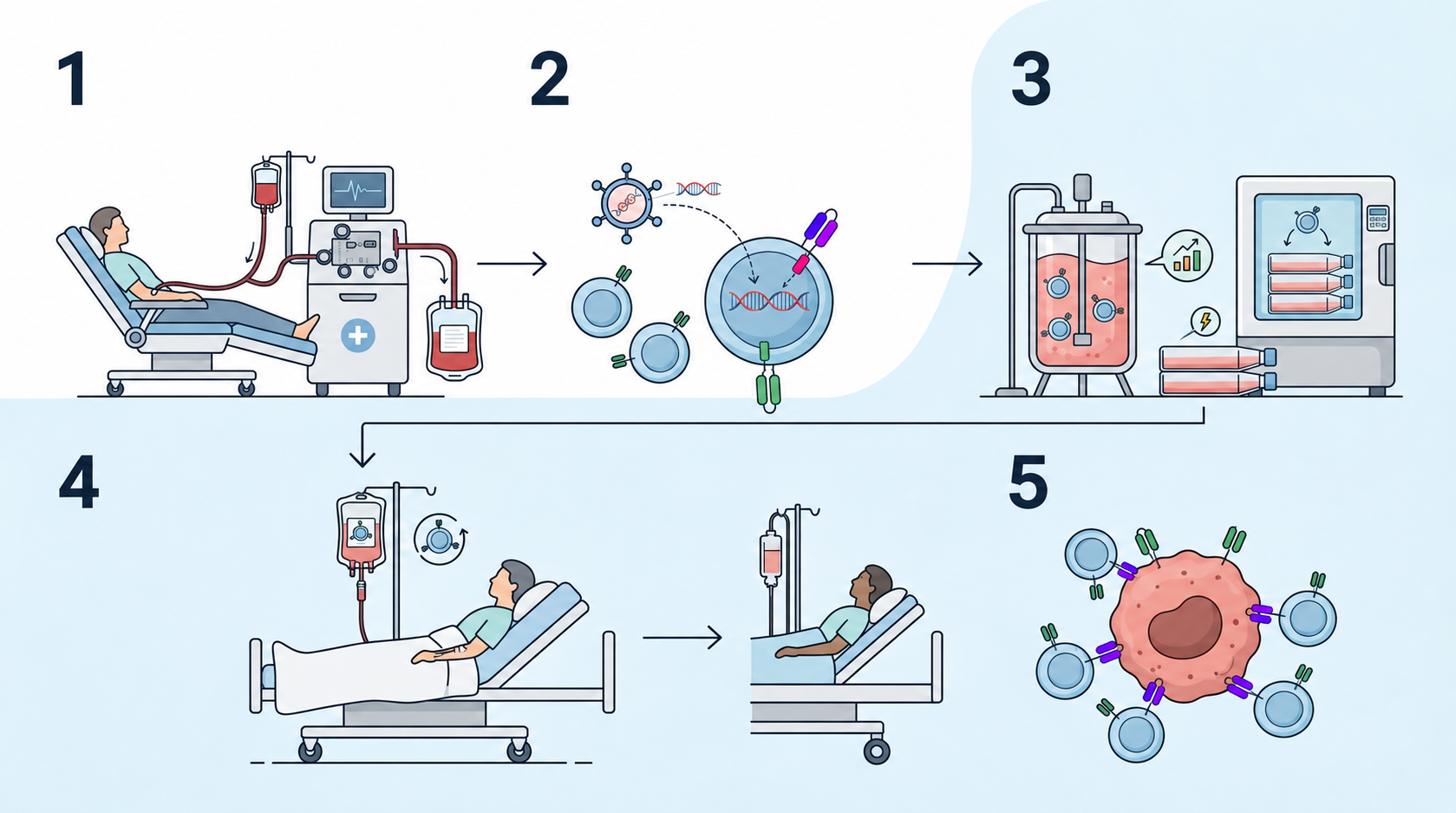
- 1
Collect T cells
Leukapheresis separates white cells from blood and returns other blood components to the patient.
- 2
Engineer the cells
Genetic material is introduced into T cells so they can produce the CAR receptor.
- 3
Expand and check
Cells are expanded and quality-tested before release for treatment.
- 4
Prepare and infuse
Lymphodepleting chemotherapy commonly precedes the intravenous cell infusion.
- 5
Monitor and follow up
The team monitors adverse events, assesses response and arranges long-term follow-up.
Individual cell manufacture may take several weeks. Interim disease-control treatment may be considered while waiting. The infusion is only one part of the overall care pathway. [12]
Which cancers have established indications?
The examples below refer to U.S. FDA indications in the United States, checked on 6 November 2026. They are not an exhaustive product list or confirmation of Thai FDA registration. [4] [5]
| Disease group | Product example | Selected eligibility conditions |
|---|---|---|
| B-cell ALL | KYMRIAH [4] | Patients up to age 25 with refractory disease or second or later relapse, as specified in the label. |
| Selected B-cell lymphomas | KYMRIAH [4] | Certain adults with large B-cell or follicular lymphoma after prior treatment, subject to product-specific criteria. |
| Multiple myeloma | CARVYKTI [5] | Adults with relapsed or refractory disease who meet the label’s prior-treatment requirements. |
Note: the cited KYMRIAH indication for follicular lymphoma received accelerated approval. Continued approval may depend on confirmatory evidence of clinical benefit, as specified by the FDA. [4]
Eligibility depends on the disease, previous therapies, overall health and local approval. The team assesses infections and organ fitness; a diagnosis alone does not establish suitability. [12]
CAR T-cell therapy and solid tumours
Solid tumours present distinct challenges. Antigen expression can vary within a tumour, its surroundings can suppress immune activity, and T cells may struggle to reach tumour tissue. [1]
Researchers are testing receptor design, cell engineering and local delivery. Early trials in selected cancers are informative, but do not establish a standard treatment for every solid tumour or patient. [9] [13]
Risks and limitations of CAR T-cell therapy
Cytokine release syndrome (CRS)
Immune activation can cause fever, low blood pressure or breathing difficulty. Severity varies, and urgent treatment may be necessary. [7]
Immune effector cell-associated neurotoxicity (ICANS)
Confusion, speech or consciousness changes and, in some cases, seizures require monitoring by the treatment team. [7]
Other risks include infections, low blood counts and longer-term immune effects. Product-specific precautions and the individual’s condition guide care. [14]
The FDA warns about T-cell malignancies after certain CAR T-cell products and recommends lifelong monitoring for secondary cancers. This supports continued follow-up; it does not mean every recipient will develop another cancer. [8]
Personalised manufacture, waiting times and specialist care complicate access. Total costs depend on the product, country and care required; the treating centre should explain costs and coverage. [6] [10]
Future directions for CAR T-cell therapy
Research explores controllable next-generation CARs, multiple-target recognition and more efficient manufacturing. Improving safety and access are goals that require evidence for each approach. [9]
Donor-derived, or allogeneic, cells could be manufactured in advance, but immune rejection and donor–recipient interactions remain challenges. Manufacturing advantages or early trial findings do not establish benefit for everyone. [10]
Frequently asked questions about CAR T-cell therapy
How does it differ from chemotherapy?
CAR T uses engineered immune cells, whereas chemotherapy uses medicines. They may be combined: preparative chemotherapy commonly precedes the cell infusion. [3]
Which cancers can it treat?
Certain B-cell ALL, B-cell lymphomas and multiple myeloma have established indications, depending on the product and country. [4] [5]
Can CAR T-cell therapy cure cancer?
Some patients achieve long remissions, but non-response and relapse remain possible. A cure cannot be guaranteed, and follow-up is necessary. [1]
What side effects can occur?
Important effects include CRS, ICANS, infections and low blood counts. Symptoms and severity vary; report unexpected symptoms to the treatment team. [14]
Is CAR T-cell therapy available in Thailand?
Thailand has research and specialist treatment programmes. Siriraj Hospital has developed and produced CAR T cells domestically and studied their use in selected patients with relapsed or refractory B-cell lymphoma and B-cell acute lymphoblastic leukaemia. Another programme is a collaboration between the Department of Medical Services and Prince of Songkla University. These programmes do not establish Thai FDA registration for every product or eligibility for everyone; confirm current access and criteria with the treating centre. [11] [15] [16]
Key message
CAR T-cell therapy adds options for selected blood cancers, with eligibility, risk and long-term follow-up central to care. Solid-tumour and newer applications need approach-specific evidence. Treatment decisions belong with a specialist team. [2] [12]
References and further reading
Sources checked on 6 November 2026.
- National Cancer InstituteCAR T Cells: Engineering Immune Cells to Treat Cancer ↗
- National Cancer InstituteT-cell Transfer Therapy ↗
- Penn MedicineCell and Gene Therapy ↗
- U.S. FDAKYMRIAH: product information and indications ↗
- U.S. FDACARVYKTI: product information and indications ↗
- American Cancer SocietyCAR T-cell Therapy and Its Side Effects ↗
- NHS Specialist Pharmacy ServiceUnderstanding acute CAR-T cell therapy toxicities in adults ↗
- U.S. FDABoxed warning for T-cell malignancies following CAR T-cell immunotherapies ↗
- National Cancer InstituteEngineering CAR T-Cell Therapy to Overcome Limitations ↗
- Peer-reviewed review · PubMedAllogeneic chimeric antigen receptor cell therapies for cancer: progress made and remaining roadblocks ↗
- Department of Medical ServicesCAR-T Cell and ATMP collaboration with Prince of Songkla University, 23 December 2025 ↗
- University College London Hospitals NHSCAR T-cell therapy patient pathway ↗
- National Cancer InstituteGD2 CAR T Cells Show Promise Against Diffuse Midline Glioma ↗
- UT MD Anderson Cancer CenterCAR T-cell Therapy Side Effects ↗
- Techsauce · 4 November 2025Siriraj CAR T-cell development in Thailand ↗
- Siriraj Hospital · Mahidol UniversityCAR T-cell research for blood cancers ↗